Last summer, my big fluffy white sheepdog went for an expensive surgery to repair the ACL joint on her back leg, a procedure that came with a lengthy recovery process. She was confined to a crate for a month and put on a strict schedule of leash walks for four months after that.
It is not in Pearl’s nature to walk anywhere. She prefers to hurtle off the veranda and zip out to the barn like a telegram, dashing back to give me an alarming newsflash and dashing off again to check if anything she said was indeed true. A calmer dog might have coped with a bum ACL better, but it was clear even to her that something needed to be done.
She submitted to rehab with surprising stoicism and had just completed her sentence when I was summoned to Sunnybrook Hospital for surgery to deal with a couple of problems that various doctors have been staring at for more than a decade. Quigg, my general practitioner of 25 years, spotted the aortic aneurysm while reading a chest X-ray way back in 2012. Cam, my cardiologist at Sunnybrook, added a leaky bicuspid valve to the to-do list.
By coincidence, I knew Cam from Allenby Public School in Toronto, where we spent six years together in the same class. Cam performed the lead role in my very first play about a wizard who casts spells that don’t come out quite right. He had great comic timing, and I told him that if he had just stayed with me, he could have spent the rest of his life looking for work. Cam had no memory of my play, but he did remember the same teacher taking us on a bus trip to see a chicken slaughterhouse. We parted company in Grade 7; he later went into pre-med somewhere and I went off to the entertainment world.
I suggested to Cam that an aneurysm is a good thing because you don’t linger as a burden to your family. It’s just lights out and everybody says, “Gosh, I didn’t even know he was sick!”
Cam sighed and said, “No, Dan. We fix it.”
The surgery went reasonably well, except that I suffered a series of little strokes that affected my speech and vision, and extended my own rehab by several months. Fortunately, we already had a crate and Pearl was happy to give it up. Quigg is a bit of a medical historian and he tells me that splitting the breastbone is the traditional death blow in medieval warfare, and the brain has great difficulty accepting that there is any further need for its services after such an event. One of the surgical team also informed me that the heart does not like to be touched. It sulks. But there was no pain to speak of, and the eight days I spent in the ICU and the cardiac ward turned out to be a rich experience. You don’t really need to travel anymore. Just spend a week in the hospital, put an umbrella in your drink, and people from every corner of the earth will come to your bedside.
We all like to moan about the awful state of healthcare, mostly because we dabble around the edges of it waiting for specialists and procedures. But if you do venture deep into the mechanics, you find that the system operates with the precision of a Swiss clock. In fact, the sign you are getting better comes when you are moved back out to the periphery and everything seems chaotic again.
Once home, the first piece of mail I received was a notice cancelling my driver’s licence and offering a labyrinthine process for getting it back.
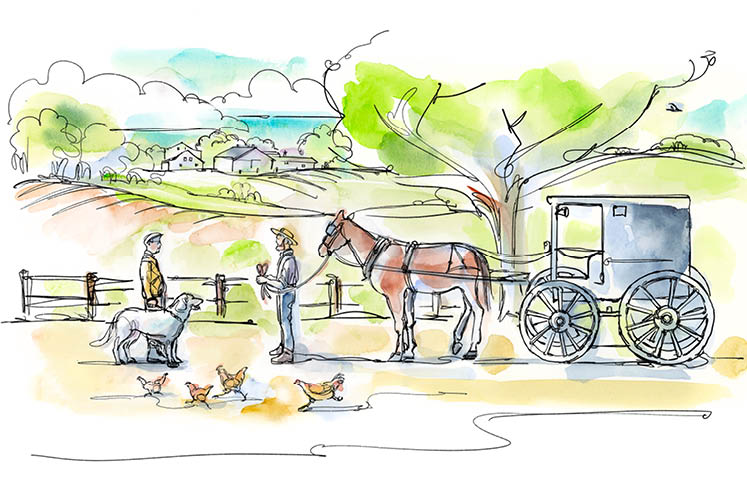
Pearl and I are taking our walks together again, sometimes in the back field and occasionally at the Homestead Dog Park where Pearl is allowed to run free, but I am still on a leash. I can’t even take the tractor out because any motorized vehicle on a highway requires a licence, but I am in conversation with an Amish friend who has offered to lend me a spare horse and cart from his stable until the specialists get together and tell me I am roadworthy again.
No licence required and he assures me the horse has had its eyes tested.
Article appeared in In the Hills Magazine March, 2026. Click to read more articles in In the Hills Magazine. Illustration by Shelagh Armstrong.